

Coconuts, cafreal and cajus
My final post about Goan food explores coconut milk, a traditional drink and Goan 'champagne'...

Listen to this on repeat while reading….
I though Goa would be one place awash with fresh coconut milk. But it isn’t. There’s roadside tender coconut vendors on almost every road bend and corner, and they literally grow on trees, so you’d think really good coconut milk would be ubiquitous here, but it just isn’t.
Which got me thinking. You can buy cartons of ready-made coconut milk in Goa, but they’re imported from Sri Lanka or Thailand, and expensive (about INR290 a litre – that’s about £2.60 or $3.30)..so what’s the deal?
Firstly, coconuts are used differently here. Goans use the abundance of fresh coconuts as a staple, but primarily – and directly – used in home cooking rather than being processed into pre-packaged coconut milk. People buy whole coconuts, grate them, and extract coconut milk fresh at home when needed. Since this is the norm, there isn’t as much demand for pre-made coconut milk as in other countries.
We had a tour guide crying with laughter at the idea of buying cashew nuts from a store…it’s the same principle with coconut milk. And I’m the idiot buying these things…
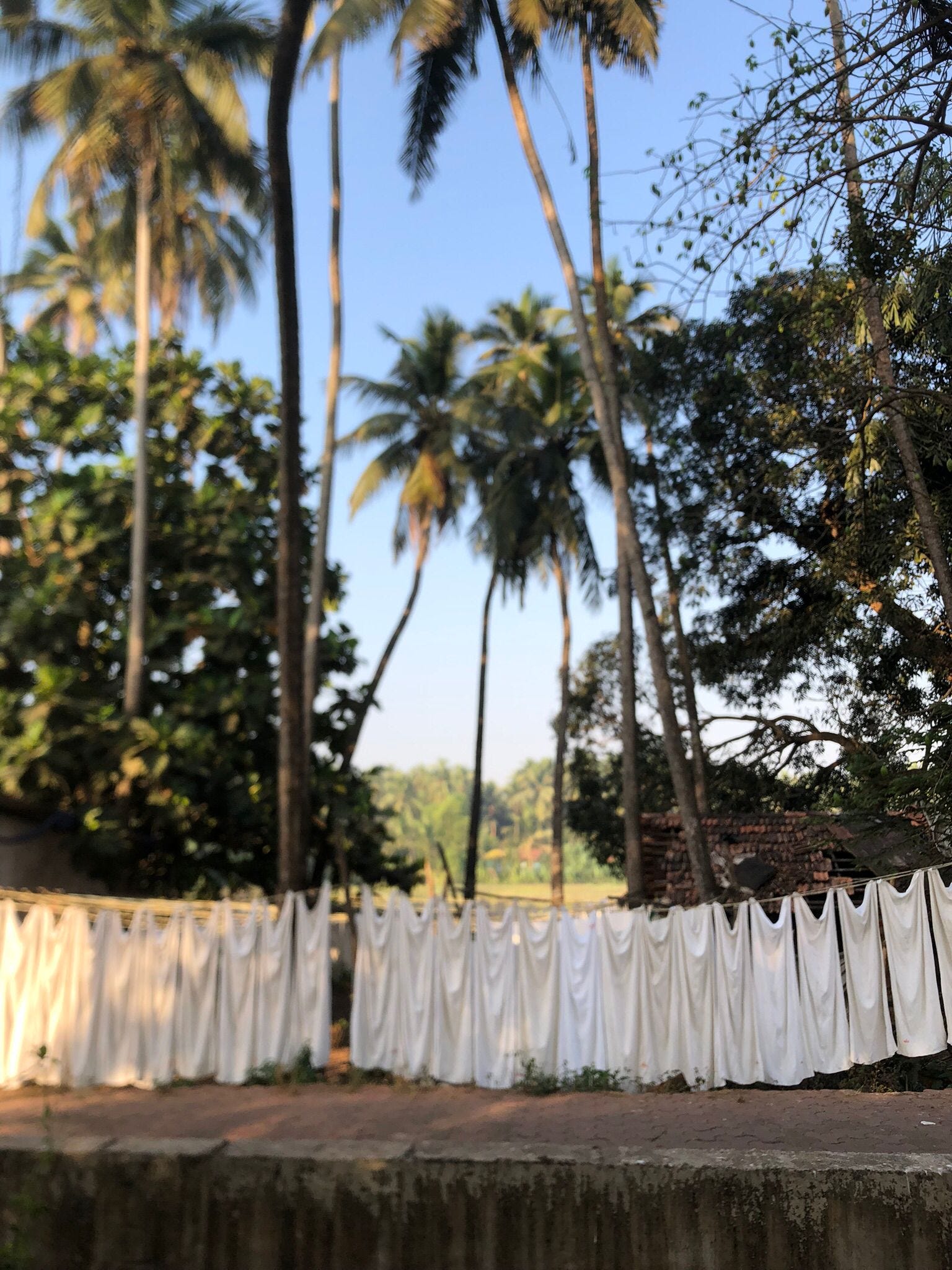
Drying the laundry under coconut trees, Saligoa
Unlike Thailand or Sri Lanka, where coconut milk is a big commercial product, Goa doesn’t have many large-scale processing plants for producing and packaging fresh coconut milk. That’s why stores usually stock imported brands rather than locally made versions.
Goans tend to use coconut in its grated form (for curries and sweets), rather than as canned or packaged milk. Many traditional recipes call for extracting coconut milk manually, so it’s not something that’s often sold separately.
And finally, fresh coconut milk spoils quickly without preservatives, which makes large-scale production and distribution a challenge unless ultra-pasteurized or canned. And, as we know, Goan’s are rightly proud of their cuisine, and using something processed or pasteurized isn’t necessary when it’s dropping from a tree right above you!
If you want the full roadside tender coconut experience, after drinking it, you can just ask the vendor to chop it open and scrape out the soft coconut from inside – known as malai in Konkani and Hindi.
You can ask the vendor: "Maka malai kadhun di?" (in Konkani) or "Malai nikal ke dena" (in Hindi), which means "Can you take out the malai for me?"
Vendors usually scoop out the flesh with a makeshift spoon made from the shell itself.
Cafreal
A common dish on every menu in Goa is ‘cafreal’. The name Cafreal in Goan cuisine originates from the Portuguese word, "Cafre", historically used to refer to people from the Kafir region of Africa, particularly Mozambique. The dish itself is believed to have been introduced to Goa by the Portuguese colonists, who brought it from their African colonies.
Galinha Cafreal (Cafreal Chicken) is a spicy, green-marinated dish made with coriander, green chillies, garlic, ginger, and spices, and it showcases the fusion of African, Portuguese, and Goan culinary influences. Over time, the recipe was adapted to local ingredients and is very much a beloved part of Goan cuisine.
The word originates from the Arabic "Kafir" (كافر), meaning "non-believer" or "infidel", which was later adopted by Portuguese explorers. Over time, the term was used broadly for people of African descent, and in colonial contexts, it often carried a derogatory or racial connotation.
But I think in the case of Goan Cafreal, the name likely merely reflects the African roots of the dish rather than being intentionally racist. However, like many colonial-era food names (such as "mulatto sauce" in some cuisines), it is tied to a historical context where racial and cultural hierarchies were enforced.
Today, the term "Cafreal" in Goa is mostly understood in a culinary sense. While the origins of the word may be problematic, its use in modern Goan cuisine does not typically carry racist intent. However, some people who are aware of its history might find it uncomfortable.
Having said all that, I took it upon myself to use tempeh to make a cafreal style dish, veganised.
Tempeh Cafreal (Goan-Inspired Spiced Tempeh)
(Note: It’s best to marinate this overnight)
This plant-based twist on the classic Goan Cafreal replaces chicken with tempeh, which absorbs the spicy marinade beautifully. It’s packed with flavour and perfect for grilling, pan-frying, or baking.
Ingredients:
200g tempeh, sliced into thick strips or chunks
1 cup fresh coriander leaves
3 green chillies (adjust to taste)
3 cloves garlic
1-inch piece ginger
1 tsp cumin seeds
1 tsp coriander seeds
½ tsp turmeric powder
1 tsp garam masala
1 tbsp vinegar (white vinegar or apple cider vinegar)
½ lime, juiced
1 tbsp coconut oil (or any neutral oil)
½ tsp salt (adjust to taste)
1 tbsp water (if needed to blend)
A splash of feni (Goan cashew spirit)
Preparation
In a blender or mortar and pestle, grind together coriander leaves, green chillies, garlic, ginger, cumin seeds, coriander seeds, turmeric, garam masala, vinegar, lime juice, salt and feni - if you have it - until you get a smooth paste. Add a little water if needed.
Coat the tempeh strips evenly with the cafreal masala and let it marinate for at least 30 minutes, preferably overnight for deeper flavour.
Pan-fry: Heat coconut oil in a pan and cook the tempeh on medium heat for about 4-5 minutes per side until golden and slightly crispy.
Grill: Preheat a grill and cook for 3-4 minutes per side until slightly charred.
Bake: Place in a preheated oven at 180°C (350°F) for 15-20 minutes, flipping halfway.
Serve hot – Garnish with fresh coriander, lime wedges, and sliced onions. Enjoy with Goan poi (bread), rice, or a side salad.
Cajus/Cashews
The humble cashew nut is a mainstay of Goan life, first brought to the state by the Portuguese via Brazil. I had the pleasure of eating my first cashew apple, straight from the tree, and it tasty like a fibrous, earthy, citrus fruit. Interesting!
Feni, mentioned in the recipe above, is a local spirit, produced by crushing cashew apples or coconut sap, with cashew feni most well-known. It has a strong, fruity aroma and a potent kick, making it a staple in Goan culture and festivities. Feni has been produced in Goa for over 400 years, with its unique distillation process and geographical significance earning it a Geographical Indication (GI) tag, meaning it can only be made in Goa.
Ripe cashew apples are hand-crushed in stone basins called colmbi, and the juice is collected. This juice is fermented naturally for a few days before being distilled in a traditional earthen pot still called bhatti. The first distillation (urrak) is weaker, and subsequent distillations increase the alcohol content, with three rounds producing the strongest feni.
Traditionally, feni was used as a natural remedy for colds, fevers, and digestive issues. It was an important product for everyone. It was often mixed with warm water, spices, or herbs as a tonic. Ayurvedic practitioners still sometimes used feni in herbal infusions to treat infections and as an antiseptic.
According to the ‘Bigfoot’ museum I visited in Goa (a story for another time, a crazy place) I learnt that in coastal Goa, feni was used as a preservative for wooden boats due to its antifungal and antibacterial properties. Boat builders applied it to wooden hulls to protect against rot and termites, and fishermen would sometimes mix it with natural resins to make a protective coating.
Feni has also long been part of Goan rituals, feasts, and social gatherings. It was traditionally offered to deities during religious festivals or used in local ceremonies. Even today, it is served at Goan weddings and celebrations as a symbol of hospitality.
Today, cashew feni is gaining popularity as a premium artisanal spirit, often featured in cocktails, culinary dishes and craft distilleries. It remains an essential part of Goan identity, loved both for its heritage and bold flavour.
That’s all folks
Dear reader, apologies for not producing a newsleter for the last few weeks. We left Goa, travelling home via Abu Dhabi for a first-day-of-Ramadan iftar, and then I caught a cold on returning to chilly London!
Love and cashews
Will
Hope you are feeling better now!